
400-998-5282
专注多肽 服务科研
400-998-5282
专注多肽 服务科研
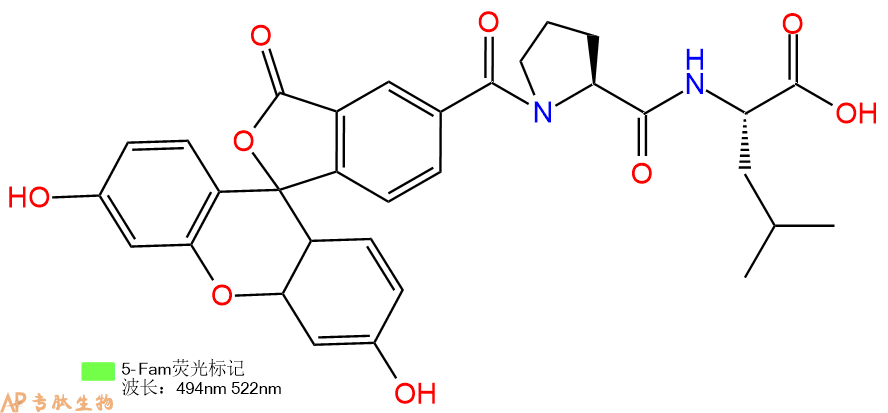
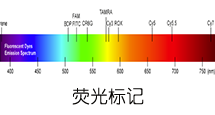
该多肽仅含 5‑FAM,与 520 MMP FRET 底物的蛋白水解产物相似。可用于建立荧光标准曲线。吸收 / 发射 = 494/521 nm。
编号:637310
CAS号:
单字母:5FAM-PL-OH
| 编号: | 637310 |
| 中文名称: | 5-FAM MMP FRET Peptide Fluorescence Standard I |
| 单字母: | 5FAM-PL-OH |
| 三字母: | 5FAM N端标记5-FAM,5-羧基荧光素(5FAM)是一种荧光染料,其激发波长为492纳米,发射波长为517纳米。在荧光共振能量转移(FRET)实验中,像FAM和5FAM这样的供体通常与受体(CPQ2)配对使用。 -ProL-脯氨酸:proline。系统命名为吡咯烷-(2S)-羧酸。为亚氨基酸。是编码氨基酸。在肽链中有特殊作用,如易形成顺式的肽键等。符号:P,Pro。 -LeuL-亮氨酸:leucine。系统命名为(2S)-氨基-4-甲基戊酸。是编码氨基酸。是哺乳动物的必需氨基酸。符号:L,Leu。 -OHC端羧基:C-terminal carboxyl group。在肽或多肽链中含有游离羧基的氨基酸一端。在表示氨基酸序列时,通常将C端放在肽链的右边。 |
| 氨基酸个数: | 2 |
| 分子式: | C32H30O9N2 |
| 平均分子量: | 586.59 |
| 精确分子量: | 586.2 |
| 等电点(PI): | - |
| pH=7.0时的净电荷数: | - |
| 平均亲水性: | -1.8 |
| 疏水性值: | 1.1 |
| 消光系数: | - |
| 标签: | FAM标记肽 600+种二肽(Dipeptide)现货 |
该多肽仅含 5‑FAM,与 520 MMP FRET 底物的蛋白水解产物相似。可用于建立荧光标准曲线。吸收 / 发射 = 494/521 nm。
This peptide contains 5-FAM only and is similar to the proteolytic product of the 520 MMP FRET substrates. It can be used to set up the fluorescence standard curve. Abs/Em = 494/521 nm.
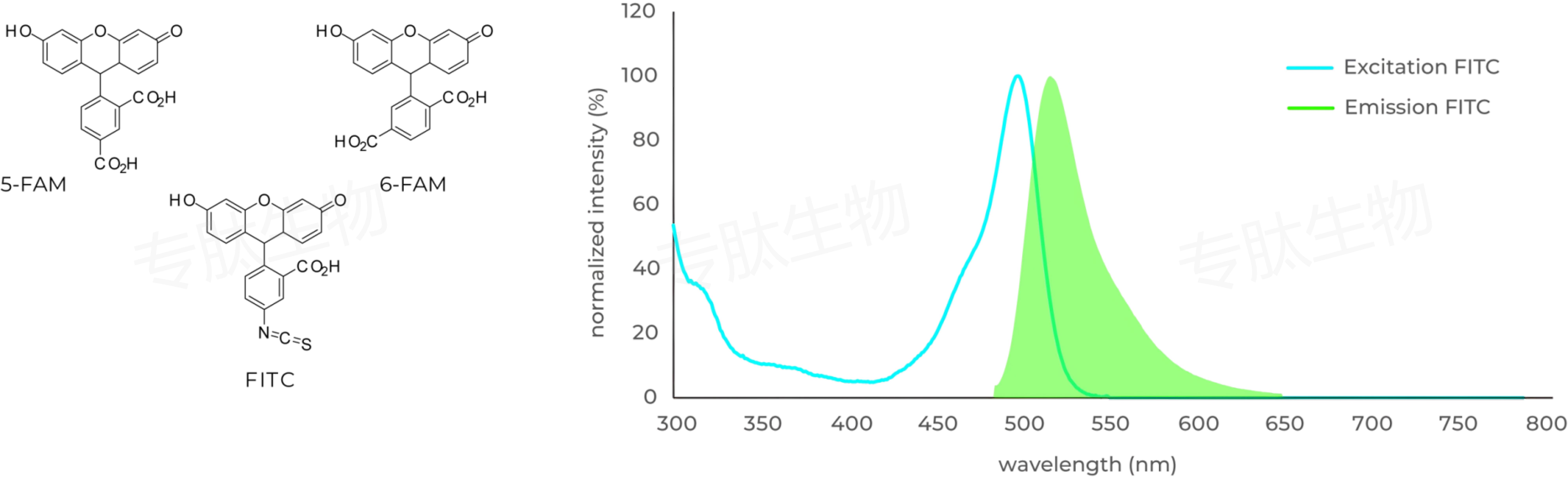
FAM标记说明:
Carboxyfluorescein (FAM) is fluorophor with an excitation at 492 nm ▉ and emission of 517 nm ▉. Donors like FAM and 5FAM are often paired together with acceptors (CPQ2) for FRET experiments.
FAM标记肽的相关文献:
Porous Silicon Nanoparticle Delivery of Tandem Peptide Anti-Infectives for the Treatment of Pseudomonas aeruginosa Lung Infections.
Kwon, Ester J., et al. Advanced Materials 29.35 (2017).
Ultrasensitive tumor-penetrating nanosensors of protease activity.
Kwon, Ester J., Jaideep S. Dudani, and Sangeeta N. Bhatia. Nature Biomedical Engineering 1 (2017): 0054.
Seneca Valley Virus 3C pro Substrate Optimization Yields Efficient Substrates for Use in Peptide-Prodrug Therapy.
Miles, Linde A., et al. PloS One 10.6 (2015): e0129103.
The function of the milk-clotting enzymes bovine and camel chymosin studied by a fluorescence resonance energy transfer assay.
Jensen, Jesper Langholm, et al. Journal of Dairy Science 98.5 (2015): 2853-2860.
A comparison of modular PEG incorporation strategies for stabilization of peptide-siRNA nanocomplexes.
Lo, Justin H., et al. Bioconjugate Chemistry (2016).