
400-998-5282
专注多肽 服务科研
400-998-5282
专注多肽 服务科研
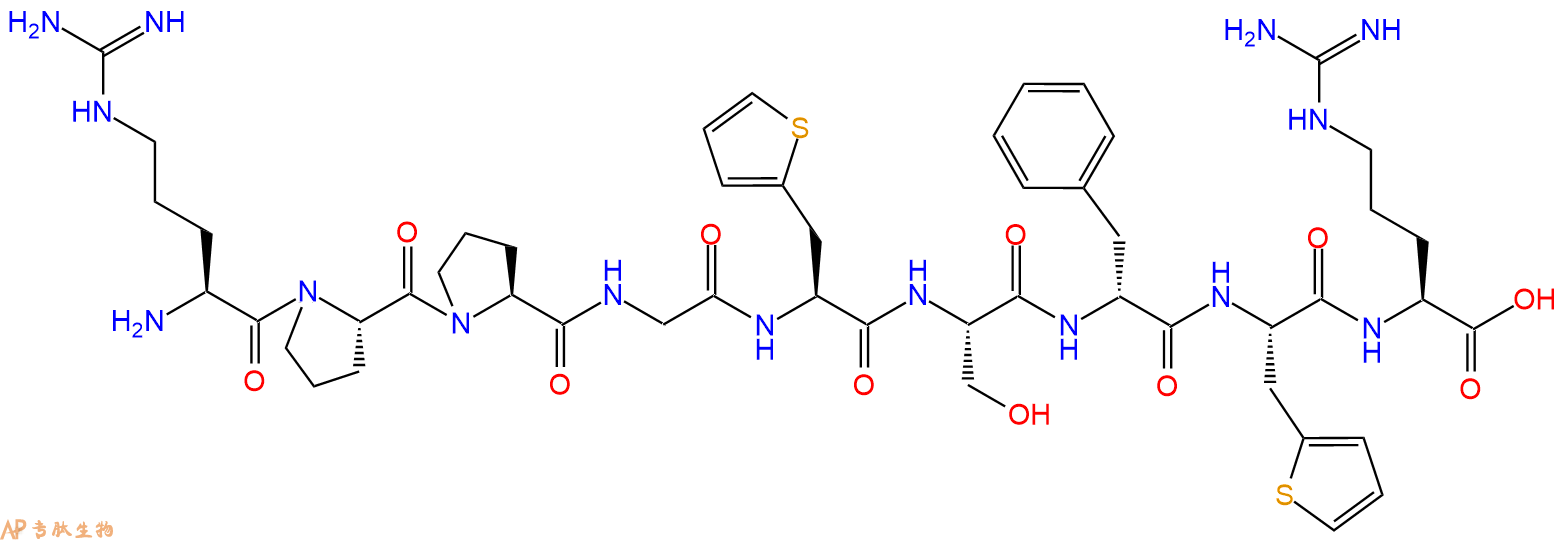
缓激肽拮抗剂
编号:114047
CAS号:97825-07-5
单字母:H2N-RPPG-Thi-Sf-Thi-R-OH
| 参考文献(References): | R.J. Vavrek et al., Peptides, 6, 161 (1985) |
缓激肽拮抗剂。
Bradykinin antagonist.
Thi⁵,⁸,DPhe⁷ 缓激肽含噻吩基与 D‑型芳香族取代,改变侧链几何与配体‑受体结合。该类似物为控制激肽家族信号的结构决定因素提供见解。序列适用于构象分析与对接研究。应用包括合成肽设计与结构‑活性定位。
Thi5,8,DPhe7 Bradykinin carries thienyl and D-aromatic substitutions altering side-chain geometry and ligand-receptor engagement. The analog provides insight into structural determinants governing kinin-family signaling. Its sequence supports conformational analysis and docking studies. Applications include synthetic peptide design and structure-activity mapping.
Definition
Bradykinin is a nonapeptide that is mainly found in animal preparations that are treated with the venom of the snake, Bothrops jararaca1,2. It dialates blood vessels that in turn leads to decrease in blood pressure2. Bradykinin analogs are slightly modified structural derivatives of bradykinin that perform similar functions as bradykinin3.
Discovery
Bradykinin was discovered in the blood plasma of animals that were treated with the venom from the Brazilian snake, Bothrops jararaca1,2. The discovery was part of a study that was related to toxicology of snake bites. Bradykinin analogs were synthesized by solid-phase techniques in 1975 and their function was studied in rats and rabbits3.
Classification
Bradykinin is a 9 amino acid peptide that belongs to the kinin family of proteins4. It has homologs in several animals including other snakes, frog, dog and humans4.
Structural Characteristics
Bradykinin has the sequence Arg-Pro-Pro-Gly-Phe-Ser-Pro-Phe-Arg3. Several analogs of bradykinin have been synthesized. They are also nanopeptides containing substitutions of various amino acids of bradykinin. For example two analogs of bradykinin were synthesized one with 7-beta-homo-L-proline and the other with 8-beta-homo-L-phenylalanine substitutions3. It was found that both of them are resistant to enzymatic degradation3.
Mode of action
Bradykinin binds to two different kinin G protein coupled receptors- B1 and B25. Upon binding to these receptors it induces conversion of GTP to GDP which in turn triggers the conversion ATP to cAM which then acts as a second messenger resulting in the activation of genes. B1 receptor is expressed as a result of tissue injury and is found to play a role in inflammation while B2 receptor participates in the vasodilatory role of bradykinin5,6. Bradykinin analogs function is a similar fashion although depending on their structure they might have varying affinities to the receptors compared to bradykinin7. Also analogs of bradykinin have been synthesized that are specific to one of these receptors7.
Functions
Bradykinin is a potent endothelium-dependent vasodilator, causes contraction of non-vascular smooth muscle, increases vascular permeability and also is involved in the mechanism of pain. Bradykinin also causes natriuresis, contributing to a drop in blood pressure8. Bradykinin raises internal calcium levels in neocortical astrocytes causing them to release glutamate9. Overactivation of bradykinin is thought to play a role in a rare disease called Hereditary Angioedema, also known as Hereditary Angio-Neurotic Edema10.
Some analogs of bradykinin have been found to have prolonged hypotensive action compared to bradykinin (Eg: beta-H-Pro-bradykinin)3. Some analogs have relative or even lower potencies compared to bradykinin (Eg: HArg1-Bradykinin and HArg9 Bradykinin)7. Other analogs have been studied for their potential of finding bradykinin antagonists that might be useful in the treatment of angio-neurotic edema.
References
1. Partridge, SM (1948). (Title or abstract not available), Biochem. J., 42, 238.
2. Allen PK, Kusumam J, Yoji S, Yoshitaka N, Berhane G, Sesha R and Michael S (1998). Bradykinin formation: Plasma and tissue pathways and cellular interactions. Clinical reviews in allergy and immunology, 16, 4, 403-429.
3. Ondetti MA, Engel SL (1975). Bradykinin analogs containing beta.-homoamino acid, J. Med. Chem.,18 (7), 761–763.
4. Roseli A, Gomes S, Jair RC, Luis J and Valdemar H (1996). Met-Lys-Bradykinin-Ser, the kinin released from human kininogen by human pepsin. Immunopharmacology, 32, 76-79.
5. Peter GM, Amrita A, and Mauro P (2000). Association between Kinin B1 Receptor Expression and Leukocyte Trafficking across Mouse Mesenteric Postcapillary Venules. J Exp. Med., 192, 367-380.
6. Duchene J, Lecomte F, Ahmed S, Cayla C, Pesquero J, Bader M, Perretti M and Ahluwalia A, (2007). A Novel Inflammatory Pathway Involved in Leukocyte Recruitment: Role for the Kinin B1 Receptor and the Chemokine CXCL5. J Immunol., 179, 4849-4856.
7. Max ES, Phyllis AL (1974). Synthesis and pharmacology of homoarginine bradykinin analog. J. Med. Chem., 17 (11), pp 1227–1228.
8. Dendorfer A, Wolfrum S, Wagemann M, Qadri F, Dominiak P, (2001). Pathways of bradykinin degradation in blood and plasma of normotensive and hypertensive rats. Am J Physiol Heart Circ Physiol., 280:H2182
9. Kuoppala A, Lindstedt KA, Saarinen J, Kovanen PT, Kokkonen JO (2000). Inactivation of bradykinin by angiotensin-converting enzyme and by carboxypeptidase N in human plasma. Am J Physiol Heart Circ Physiol, 278(4):H1069-74.
10. Bas M, Adams V, Suvorava T, Niehues T, Hoffmann TK, Kojda G (2007). Nonallergic angioedema: role of bradykinin. Allergy, 62(8):842-56.
很多蛋白在细胞中非常容易被降解,或被标记,进而被选择性地破坏。但含有部分D型氨基酸的多肽则显示了很强的抵抗蛋白酶降解能力。
【拮抗剂多肽在癌症治疗中的作用机制】
1 、抑制肿瘤细胞增殖:某些多肽能够直接作用于肿瘤细胞,干扰其增殖信号传导路径,从而抑制肿瘤细胞的增长。
2 、诱导肿瘤细胞凋亡:多肽可以通过模拟肿瘤抑制蛋白或激活凋亡信号通路,促进肿瘤细胞走向程序性死亡。
3 、免疫调节:多肽类化合物能够激活机体的免疫系统,增强免疫细胞对肿瘤细胞的识别和攻击能力,从而辅助控制肿瘤生长。
4、阻断蛋白质相互作用:多肽可以设计成特定的结构,以阻断肿瘤细胞内部或肿瘤微环境中关键蛋白质的相互作用,这些相互作用对于肿瘤的生存和扩散至关重要。
5、抑制肿瘤新生血管生成:多肽通过抑制血管内皮生长因子(VEGF)等促进血管生成的因子,切断肿瘤的血液供应,抑制肿瘤生长和转移。
6 、靶向递送:多肽可以通过与其表面受体特异性结合,实现对肿瘤细胞的靶向递送,提高药物的疗效并减少对正常细胞的毒性。




sales@allpeptide.com