
400-998-5282
专注多肽 服务科研
400-998-5282
专注多肽 服务科研
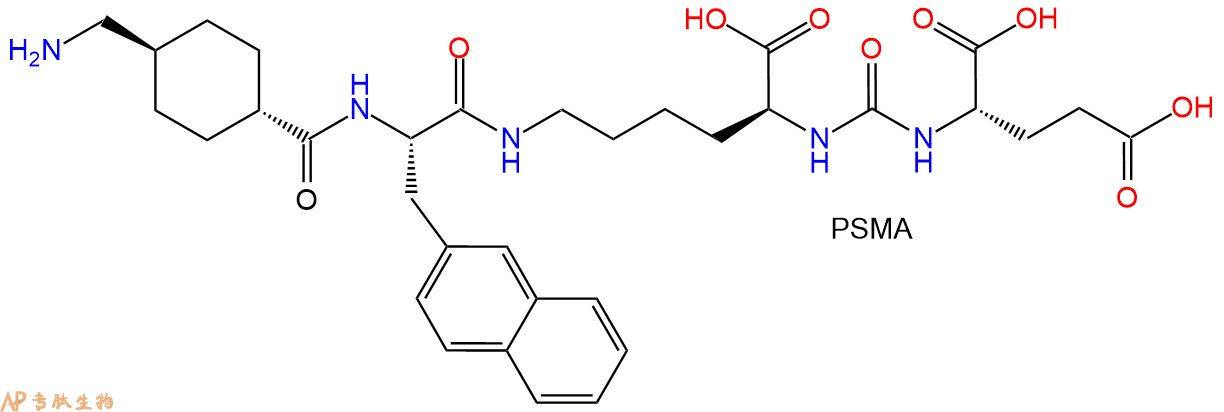
Vipivotide tetraxetan Ligand-Linker Conjugate (PSMA-617 Ligand-Linker Conjugate) 是药效基团 Glutamate-urea-Lysine 肽偶联连接子组成的复合物,可用于合成 Vipivotide tetraxetan (PSMA-617)。
编号:504352
CAS号:1703768-74-4
单字母:H2N-TranexamicAcid-2Nal-PSMA-OH
| 编号: | 504352 |
| 中文名称: | Vipivotide tetraxetan Ligand-Linker Conjugate |
| 英文名: | Vipivotide tetraxetan Ligand-Linker Conjugate |
| 英文同义词: | (((S)-5-((S)-2-(trans-4-(Aminomethyl)cyclohexane-1-carboxamido)-3-(naphthalen-2-yl)propanamido)-1-carboxypentyl)carbamoyl)-L-glutamic acid , Vipivotide tetraxetan Ligand-Linker Conjugate |
| CAS号: | 1703768-74-4 |
| 单字母: | H2N-TranexamicAcid-2Nal-PSMA-OH |
| 三字母: | H2N N端氨基:N-terminal amino group。在肽或多肽链中含有游离a-氨基的氨基酸一端。在表示氨基酸序列时,通常将N端放在肽链的左边。 -TranexamicAcid氨甲环酸 -2Nalβ-(2-Naphthyl)-L-alanine是一种非天然的双环芳香族氨基酸,已被用于合成具有增强结合亲和力的肽类(包括胆囊收缩素、血管活性肠肽和神经降肽类似物)。 -PSMAPSMA -OHC端羧基:C-terminal carboxyl group。在肽或多肽链中含有游离羧基的氨基酸一端。在表示氨基酸序列时,通常将C端放在肽链的右边。 |
| 氨基酸个数: | 3 |
| 分子式: | C33H45N5O9 |
| 平均分子量: | 655.74 |
| 精确分子量: | 655.32 |
| 等电点(PI): | - |
| pH=7.0时的净电荷数: | 0.97 |
| 平均亲水性: | - |
| 疏水性值: | - |
| 消光系数: | - |
| 来源: | 人工化学合成,仅限科学研究使用,不得用于人体。 |
| 纯度: | 95% 或98%可选 |
| 盐体系: | 若定制,可选TFA盐、醋酸盐、盐酸盐和柠檬酸盐等 |
| 生成周期: | 现货或定制2-3周,请咨询销售人员 |
| 储存条件: | 负80℃至负20℃ |
| 标签: | 氨基酸衍生物肽 Peptide linkers (ADC Linkers) 三肽 PSMA探针/定制 |
Vipivotide tetraxetan Ligand-Linker Conjugate (PSMA-617 Ligand-Linker Conjugate) is a complex composed of pharmacophore group Glutamate-urea-Lysine peptide coupling linker, which can be used to synthesize Vipivotide tetraxetan (PSMA-617). Glutamate-urea-Lysine selectively binds to prostate-specific membrane antigen (PSMA)
Vipivotide tetraxetan Ligand-Linker Conjugate (PSMA-617 Ligand-Linker Conjugate) 是药效基团 Glutamate-urea-Lysine 肽偶联连接子组成的复合物,可用于合成 Vipivotide tetraxetan (PSMA-617)。Glutamate-urea-Lysine 可以与前列腺特异性膜抗原 (PSMA) 选择性结合。
ADC linkers的介绍
ADC linkers are one of the three main components of the antibody drug conjugates (ADC) that connect an antibody with a potent drug (payload) through a chemical bond.
Role of ADC Linkers
ADC linkers play key roles in determining the overall success of the Antibody Drug Conjugates. One of the main challenges in developing a safe and effective ADC drug (Figure 1) is the assembly of a desirable chemical linker between cytotoxic payload and mAb. A well-designed ADC linker can help the antibody to selectively deliver and accurately release the cytotoxic drug at tumor sites. It also plays critical roles in an ADCs' stability during preparation, storage, and systemic circulation. A stable ADC drug ensures that less cytotoxic payloads fall off before reaching tumor cells, increasing safety, and limiting dose.
There are two main categories of ADC linkers in current ADC drugs, cleavable linkers and non-cleavable linkers.

Figure 1. There are three major components of an ADC drug; the antibody used, the linker, and the payload to be delivered.
Cleavable linkers are designed to be stable in the bloodstream and then release the payload once in the cell. Cleavable linker types include enzymatically-cleavable peptide linkers, acid sensitive hydrazone linkers, and glutathione-sensitive disulfide linkers.
Example of Cleavable Linkers in ADC

Figure 2. Adcetris with enzymatically cleavable val-cit linkage.
The non-cleavable linkers, such as SMCC, rely on lysosomal degradation within the cell to release the drug payload.
A summary of linker types is provided in Table 1.
Table 1. Linker type, mechanism and advantages of cleavable and non-cleavable linkers.
| Linker | Strategy | Mechanism | Advantages |
| Cleavable Linker | Peptides | Selectively cleaved by hydrolytic enzymes | Stability during circulation Hydrophilicity Traceless release of payload |
| Hydrazone | Acid-sensitive environments endosomal (pH = 5-6) lysosomal (pH = 4.8) | Intracellular release of payload | |
| Disulfide | Intracellular reducing molecules, such as glutathione | Intracellular release of payload | |
| Non-cleavable Linker | Stable linker without cleavage mechanism | Unknown mechanism of lysosomal cleavage | Stability during circulation |
An interesting part of the ongoing discussion about linker stability is whether the payload can or should be released into the area outside of the tumor cell. This effect, referred to as the ‘bystander effect’, is seen by some as a beneficial attribute for an ADC to display. However, recent studies indicate that, depending on the linker and payload combination, this mechanism may not be essential, and ADCs can be cleaved extracellularly or via other mechanisms.
PEG Increases the Solubility of ADC Linkers
The solubility of the linker is another parameter that has been explored using Monodispered PEG chains. Two of the latest ADCs to be approved, Trodelvy and Zynlonta, were developed with PEG moiety as part of their linker technology to improve solubility and stability in vivo.
Example of ADC Linkers with PEG Chain

Figure 3. Zynlonta, shown above, has several unique features including a maleimide group for attachment to the mAbs, a PEG8 linker for solubility, and a cleavable Val-Ala section bound to the drug SG3199.
Journal Reference:
Halford, "A new generation of antibody-drug conjugates for cancer patients", Chemical and Engineering News, vol 98, 14, (2020) https://cen.acs.org/biological-chemistry/cancer/new-generation-antibody-drug-conjugates/98/i14
Staudacher, Brown, "Antibody drug conjugates and bystander killing: is antigen-dependent internalisation required?", Br J Cancer 117, (2017): 1736–1742, https://www.nature.com/articles/bjc2017367#citeas
Joubert, et al., "Antibody-Drug Conjugates: The Last Decade", Pharmaceuticals (Basel, Switzerland) vol 13,9, (2020): 245-276, https://pubmed.ncbi.nlm.nih.gov/32937862/
前列腺特异性膜抗原(prostate-specificmembraneantigen,PSMA)是存在于前列腺细胞膜的一种多功能的Ⅱ型跨膜蛋白,由750个氨基酸残基组成。PSMA具有较高的前列腺组织特异性,在区分前列腺癌和其他类型恶性肿瘤的敏感度和特异性分别是65.9%和94.5%,因此PSMA仍然是前列腺癌细胞上一个相当敏感的、高度特异性的抗原物质。PSMA在前列腺组织良、恶性鉴别中优于PSA,且临床分期越晚,其表达越强,与肿瘤恶性程度成正相关。因此PSMA是较PSA更具特异性的前列腺癌瘤标志物,可作为前列腺癌预后评估的重要指标。